Thursday, July 14, 2016

Mini Book with Stitched Signatures Tutorial


I had a ton of fun making these two little books. There are many tutorials out there on how to make mini/micro books, but none that included how to stitch the signatures. Most of the others created binding out of gluing together a bunch of folded pages. However, I wanted to make a book as true to form and durable as possible, so I went with a good, old fashioned, stitched set of signatures.


 What you will need:

  
1. Very thin paper sheets (Steps 2, 3 & 4)
          - I used white origami paper. It folds nicely and due to its thinness, I was able to make many pages.
2. Stiffish paper for the binding, spine inlay & endpapers. Some of this will be seen. (Steps 8, 9 & 10)
          -  I used a scrapbooking background paper with a nice pink floral pattern.
3. Thin cardboard, 1.2 mm - 1.4 mm thick (Step 10)
          -  I used some stiff gift tags
4. Material for your cover (Steps 11 & 12)
          - I used fabric, but only because I couldn't find a thin enough bit of leather
5. Needle and thread (Steps 4, 5, 6 & 7)
          -Color is not relevant as you will not see it in the finished product. I used simple white thread off a spool.
6. Very small binder clips, at least 2 (Almost every step)
          -These are absolutely necessary. It is highly unlikely that your books will stay together without these.
7. PVA Glue & something to spread it with; your finger is a good option. (Steps 8-11, & 13)
8. Ruler (Almost every step)
9. Cutting tools
          -Specifically scissors, and a paper cutter if you can get it or whatever you need to help you cut your pages super straight. A ruler and exacto knife could work.
10. Very thin ribbon or thread for bookmark, if desired. (Step 9)

Step 1

Gather your materials and plan out your book.

Decide the size and thickness of your book. I made my pages 1.5 x 1 inches. I couldn't decide between a black cover or a white cover (I found material that I loved in both black and white), so I made both. These books also have approximately 76 pages each, which made the spine approx. 1/4 inch thick.
I also wanted to include a bookmark inside, and a chain around the outside, so this is where I planned that out, as well.

Step 2

Cut out & fold your pages.

A group of 5 signatures, each 16 pages long, made from 4 pieces of paper
Cut out your page sheets the height of your book by 2 times the width of your book. Each of these sheets will become four pages. Fold each of these sheets in half, making a very crisp fold. I used a bone tool, but your fingernail, a ruler, or a pencil can do the trick, too. 

Note: the first page of your first signature and last page of your last signature will not be visible in the finished book.
I had already decided that I wanted my finished book to be 1.5 inches tall by 1 inch wide.  This means that I needed to cut out sheets that would be 1.5" x 2", as they were to be folded in half to create the pages and signatures. 
Again, do whatever you need to to get these sheets as straight as possible and as uniform as possible when you cut. The straighter and more uniform the cut, the better the book will look.

Quick Terminology
Signature: In printing, a signature is a group of pages bound together.
Fore edge: the side of the book that opens, opposite the spine.

 Step 3

Assemble your signatures by nesting your cut and folded sheets.

Each piece of folded paper, or sheet of paper, represents four pages. Take your folded sheets and nest them inside each other to make signatures. Be careful not to make them too big, and make all your signatures the same number of pages.

6 holes in the spine, each 1/8 inch apart
Initially I tried to put five sheets in a signature, but they did not fit. I went with only four sheets per signature which worked a little better and gave me 16 pages per signature. This is where using the super fine Origami paper comes in. It is important to remember that paper has some depth, and when working in this small of scale, it has more than you expect, especially once it is folded.
You will also likely notice that your pages do not line up on the fore edge (the side opposite the spine). Don't worry about it for now. It will actually make it easier to flip through the pages if you leave it - some professionally published books do - but you can trim it off after the stitching if you'd like.


Step 4

Measure, Mark and Drill Signatures for Stitching

Drill holes with the needle from inside the Signature


You will need six holes in each of your signatures. It is easier to mark them if you keep them the same distance apart. Decide how far apart you want your holes, and how far from either the top or bottom of the book you will start them.
 
Single Signature with Holes


Once you are sure of your measurements, make certain your signature is lined up, and drill holes from the center page out, through the entire signature at once.

There is more space on the bottom than top, but each is the same.


 Repeat with all your signatures, making sure that the holes line up with each other on each signature.

 Take a moment to use a binder clip and put your freshly drilled signatures together on the fore edge to see if your book's spine is as thick as you'd like it. Add more signatures if desired.
This is where I started to really get excited.

Step 5

Stitch your first signature

This picture is pretty, and the thread is pretty long.

This part can be a bit tricky. It is also very important, so be sure to take the time to do it right.

Begin by cutting a fairly long bit of thread. My thread for this book was probably two feet.

Fold the thread in half, and thread the needle with the cut ends. Or, thread the needle on the folded middle and run the needle down the threads to near the cut ends.


No knots here. Just thread the needle through the end loop.


Open your first signature and attach the binder clip to one end of the sheets. This is important as you pages will slide around and drive you crazy if you don't. Also, your stitching will not be as tight and will weaken your bindery overall.

Beginning on the OUTSIDE/SPINE of your signature, run the thread through the TOP hole, leaving a loop at the end. Send the needle through the next hole, from the INSIDE, and thread it through the loop.

Stitch a very simple IN and OUT pattern through the remaining holes. You should end up with your thread hanging out the SPINE side of the signature in the 6th and BOTTOM hole. Do NOT cut the thread.


Step 6

Stitch your Next Signature, Attaching it to the First.

Lay your next signature atop the stitched signature and line up your holes. Move the binder clip to hold all of Signature 1, and half of Signature 2.

It's coming together! Literally!


Run your needle and thread from the OUTSIDE/SPINE of Signature 2, through the bottom hole, toward the INSIDE. Pull tight. You won't be able to pull tight without your binder clip holding everything steady.

Sounds simple, so let's mix it up a bit here.
Tie a knot between Signatures 1 & 2
Run your needle through the next hole up, from the inside out. Once your needle is out the spine, run it under the thread on the same hole in Signature one, and tie a simple knot, pulling everything tight.

Simple knot, nothing fancy.
Run the needle and thread from the spine to the inside in the next hole, and back out the next one up.

Back in again!
 Repeat the tying process every time the needle come out the spine on the outside. Your two signatures should be held together in four points: top, two middle stitches, and the bottom.


Step 7

Stitch your Next Signature
Knotty, knotty...


Lay your next signature atop the stitched signatures and line up your holes. Move the binder clip to hold all of your previous signatures and half of your current one.

Place your first stitch from the Spine toward the interior. Come back toward the spine on the next one down, knotting in the stitch from the previous signature.


Don't forget to stitch together the ends!


 Repeat for the remaining holes. When you reach the last hole, remember to tie it to the previous signatures before moving on.


Five signatures total.


Repeat step 7 ad naseum, or until you've added all the signatures you want. Remember to use your binder clip and keep things tight!


We're starting to look like a real book here!


Knot off your thread well and cut the excess.


Step 8

Cut and Attach Endpapers to Signatures


Using your lovely, stiff paper, you will cut out some endpapers. These papers will be seen on the inside cover of your book and before the first page and after the last page. Again, I used scrapbooking paper for this because I wanted it to be pretty.

Some part of me is always sad they're not green.
Cut out two pieces of stiff paper the same size as your original sheets of paper (same height but double width of folded signature). Fold these in half so that they are the same size as your bound pages. Make sure the pretty side is in.

Glue an endpage to the front and one to the back of your bound set of signatures with the fold in line with your book's spine. Be careful that the glue doesn't squeeze out and get all over your pages. Put the binder clips on both the spine and fore edge until the glue has set. Remove spine side binder clip for the next step.


Step 9

Cut and Attach Spine Backing (& Bookmark if Desired)


With your totally awesomely stitched signatures secured tightly in your binder clip, measure the width of your spine. Now add about 1/2 inch to that.

Scored and folded. Don't forget the binder clip!
Cut a piece of your stiff paper (Item #2 on the materials list) to the (exact height of your pages) by (spine width plus 1/2 inch).  My book, being 1.5 inches tall, has an inner spine inlay of 1.5" by about .75".

Next, make two folds in the center of your backing, so that the distance between the folds is slightly larger than your spine width. Slightly larger being about the-thickness-of-the-backing-paper larger.

Because I used scrapbook paper, my backing would not fold cleanly. I wound up using an exacto knife to score one side of the paper and get a good fold.

-- If you want a bookmark, now is the time.
Cut a piece of ribbon or string to your desired length. Place it between the signature binding and backing paper during the next step. ---

Inlay and bookmark glued, use the binder clips for 10 minutes.
Next, Make sure you still have your binder clip on the fore edge of you signatures, leaving the spine exposed. Place glue on the inside of you backing paper, over the entire inner surface. Be careful not to use too much, as it can make a mess on your pages.

Place the signature spine between the folds of the backing paper in the glue. Bend the backing and glue to the sides of your book. Quickly put another binder clip on the spine backing paper! Now leave it alone for at least 10 minutes. Stretch, get a snack, whatever, just don't open it too soon. :)


Step 10

Measure and Cut Spine Inlay and Case


When you can't find what you need it's time to get creative.
Time to make the structure of your cover! I couldn't find anything suitable at the craft store as a stand-alone item, but these little gift tags were perfect.

Making certain that your comers are a solid 90 degree angle, cut two identical pieces of the cardboard to your desired book size. I strongly suggest making them the same size as your bound signatures. The cover wrapping will make the finished cover just larger than your book interior.


Measured and marked, ready to cut.


Next, cut out the spine inlay from your stiff paper.  This should be the same height as your book, and twice the current width of your spine. If the spine inlay is not wide enough your book will not close properly.

Remember that your spine is wider now than it was when you measured it for the backing paper.


Ready for the last couple steps!


Step 11

Assemble the Cover


This is a good time to test your cover material's ability  to hold glue, especially if it is fabric. The fabric I purchased oozed glue through it, and the beautiful pattern on the black cloth was obscured. I ended up folding it in half and the glue from the boards was enough to hold it in place.


Folded cloth, ready to be made into a cover.


Rough cut material with boards and inlay, ready to glue
Lay your cover boards out, one to either side of your spine inlay, on top of the cover material. There is no need for precise measurements at this point, you will trim down the material after gluing the boards and inlay.


Next, spread a nice, even layer of glue on your spine inlay, and glue it, straight as possible, onto the wrap material. Likewise, glue the cover boards to either side of the spine inlay.

It is important here to make sure everything lines up very nice and straight. There is no need to overlap your inlay and cover boards.

Trimmed wrap with glued Spine Inlay and cover boards


Pressing with something heavy while the glue dries is a good idea at this point, though not strictly necessary.

Once the glue on your boards, spine and wrap are dry, trim down your wrap material, leaving about 1/8 inch or so on each side. You want enough material from your wrap to hold securely to the inside of your cover.


Cut out small triangle sin corners, leaving 2mm space uncut


Cut the corners as shown in the picture to the right, leaving about 2 mm of uncut cloth around each side.

Warning: Do not cut all the way to the cardboard! If you cut all the way to the cardboard it will show through after wrapping.


Step 11

Glue in the corners of the wrap

Wrap the Cover


We're almost finished! Time to wrap the cover.

Fold the corners of your wrap material over the corners of your cover boards and glue them.
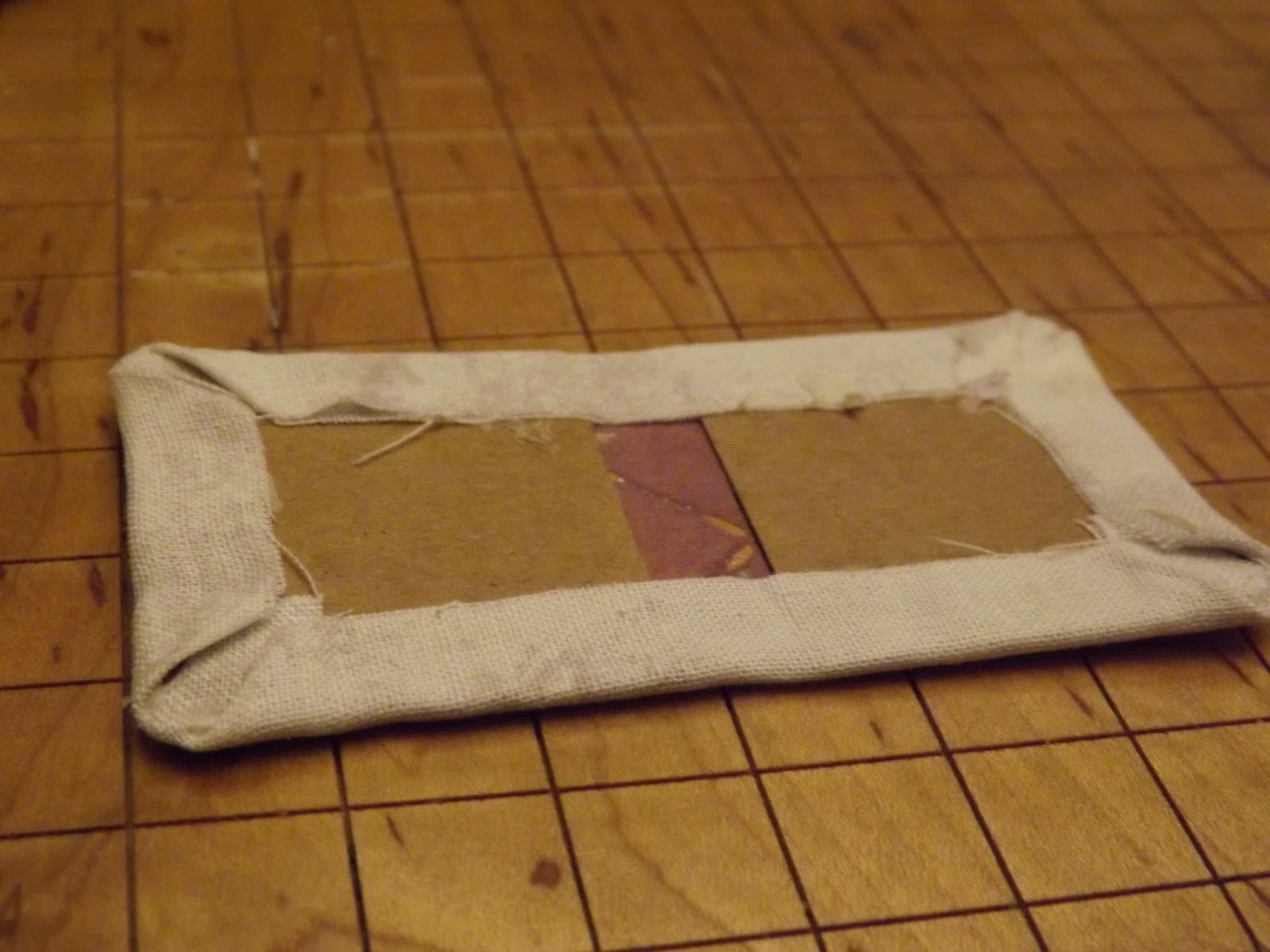


Glue in the edges.


Now, glue in the edges of your wrap.


Almost ready for final assembly!

Step 12

Curve the spine.

Curve the spine


This is a very simple but very important step.

Bend your spine inlay over something round, such as a pencil or straw. Lacking these, just try to bend it so it is nicely curved or rolled.

If you skip this step your book will not open nicely once assembled.


Step 13

Awaiting the glue

Final Step - Attaching the Cover


We made it to the final step! A few warnings before we begin.
  - Be careful! This step is crucial to the finished look of your book, and you won't get a second chance
   - Use the binder clips after gluing! It is imperative that after gluing, the binder clips are attached on both the fore edge and spine and left there for at least 10 minutes while the glue sets. Otherwise your cover will not sit straight on the book.


 - Line up your cover with the spine of the book! The boards from your wrapped cover should line up exactly with the spine of your bound pages. the Spine Inlay should not touch your pages at all. Be precise.

Once you're sure you've got these thing ready, spread glue evenly on the inner part of your front cover and press the outer side of your endpaper to it. The line of the spine must line up with the line of the cover board.

Put the binder clips on and wait at least 5 minutes before repeating the process for the back cover. make sure to line up the spine with the cover board.  Put the clips on and wait for 10 minutes before playing with it. This will essentially 'close' your book.

Note: The spine inlay get no glue. There should be space between the spine inlay and the spine.


Post- Assembly Check

Your book is now finished! You only need to check to make sure it works properly. Your cover should open and close easily and smoothly. There should be no tugging or tension on the spine. When open the spine inlay should make a lovely little semi-circle.

Congratulations! You made a book!

If it didn't turn out, learn from your mistakes and then try, try again!


While generally bad for a book, this is a good test of the spine.
A nice little rounded spine.

A matched pair
The mess it all left.

I added the chain by drilling a hole in the spine with the needle.

I threaded a ring through the hole and attached the chain.

The various decorations were then added to the ring and chain.


Cute set of valentine's gifts :)


Friday, June 12, 2015

The argument over Vaccines

Today I came across this image.


I've read some of the back and forth between vaxxers & anti-vaxxers, so I understand, to a degree, some of the arguments.  But this really made me pause.  I want to point ou that this isn't about people who Can't vaccinate their kids, but rather it is about the people who Won't.

The fact is, that for me, this is so completely not the issue.  I don't have a moment's pause for my vaccinated kids.  They can totally play with unvaccinated kids all day long an it doesn't bother me one iota, because I am so sure the vaccines work (within the bounds of effectiveness, of course).
One of the commenters on this image said something to the effect of "why should I care about your kids? It's my job to care about my own."  I feel this is a pretty valid argument, for some things.  However, we also live in a society and part of being in a society is caring for those around you.  More accurately, this is the job and responsibility of those living in a community.  I posit that almost none of us live in real communities anymore, which is why this attitude exists.  However, that is not the issue I wanted to address so we'll leave the community discussion for another day (if you want an interesting insight for it, read the 2nd to last chapter of "Dumbing Us Down" by Gato.  It's about the public school system, but I felt that chapter had a lot of Truth and Insight into what communities really are, and realized that for the most part, I've never lived in one outside of my extended family).

Lets talk about pregnancy, birth and babies for a minute.  I don't know about you, and what your experiences have been.  I only know mine, and a small portion of other people's.  For me though, pregnancies are hard.  My pregnancies aren't "Difficult Pregnancies," but they are hard.  The first couple weeks are fine, and because I chart I know I'm pregnant about a week after conception.  But then I start getting sick.  Not the lovely puke-once-and-be-chipper-the-rest-of-the-day sick.  I wake up nauseous, I dry heave for minutes on end because my stomach is empty, I can't eat much of anything without throwing it up and dry heaving more and throwing up/dry heaving is painful.  It's utter wringing of my stomach, twisted and stomped on, over and over and over.  And should I actually bring something up (usually I dry heave until whatever stomach acid is in my stomach comes up) it burns.  And I am nauseous All.  The.  Time.  Yes, I took medicine to help, but it was just a case of orders of magnitude.  I wasn't as nauseous, didn't dry heave as much, didn't wish myself into non-existence as much.   There was also much pondering on the wisdom of continuing on in such misery.  Plus very serious weight loss. And this for weeks.  9 weeks, actually.  That seems like a short time.  Just two months.  Just nine weeks.  Just 63 days.  Just 189 meals.  Just 1,512 hours.  Just 11,340 minutes.  Until it is constant, unrelenting and continuous.  Then it is an agonizing amount of time.
Moreover, it's an awful lot of effort.  On top of having to take care of the house, and the other kids, and the spouse, and the job, and the pets, and the cooking, and the shopping, and the everything else.  When it takes everything you've got to get up because life is so much worse when your vertical.
But, at least there is an end in view, with a bundle of happiness waiting, so you push through and eventually it's behind you.
Then things are hunky dory for a bit as you start to get larger and larger. And you have to pee all the time.  And you don't quite fit into anything anymore (doors, cars, chairs etc).  And you can't sleep comfortably, and then you can't sleep at all.
For 9 months you've been giving up yourself.  For 38 weeks you have been sacrificing your body.  For 266 days you have slowly been sacrificing your self, what you once were, heading imminently toward something new and utterly life altering.   For 6,384 hours you have worked.   And then Labor begins and you work some more.
Labor and Birth.  Compared to the time that pregnancy lasts, the time that life encompasses, it is a mere blip.  But what a blip.
Now, I am a big fan of epidurals.  Absolutely, every time for me (I'm also a big fan of every woman choosing the method that is right for her).  My first child was induced, so aside from some discomfort of very early labor before my epidural there wasn't much to that one as far as work went.  Easy peasy.  My second child began labor spontaneously. It took about a half hour from the time my water broke to get everything together and get to the hospital.  Now, I have very quick labors, so I was having contractions less than 5 minutes apart by the time we got into the car.  I thought those were pretty bad, but after several minutes of what I thought was horrible, horrible pain over and over, I finally got my epidural and everything was great.   ...except it wasn't.  My son was 3 days early and his lungs weren't developed quite enough and he was swiftly whisked off to the NICU.   And for the first time I felt real Fear.
I felt the all-too-real Fear that my child, my little baby, would die.  I had only had him for minutes, for a couple hours, but I loved him so deeply.  I had sacrificed for him and was not yet done with my sacrifice to bring him into this world, to provide him with a body, to give him a chance at Life.  And I had Fear.
Fortunately, after a week in the NICU accompanied by a spinal headache and gallstones throughout, I was able to bring my precious child home.   But now I knew Fear, and Fear did not leave me for weeks.
My third birth was different.   The pregnancy was much the same, 2 months of abject misery followed by 7 months of increasing discomfort, change and sacrifice, etc.  But now I was acquainted with Fear, real Fear.  And Fear returned to me, bit by bit, as Birth approached.  Fear that we'd again be too early, that we'd again be in the NICU, that we would again be facing Death.  And Fear grew as I started having preterm contractions on and off.  The last week before we hit 'term' was agonizing, immobilizing with Fear.  But we made it.  Barely.  At 2AM of the first day of week 37, I went into real labor.
To this point I had been acquainted with Sacrifice, Fear, Work, and some degree of Pain for my babies.   But this one was different.  Because I birth quickly, I had only 1 hour left by the time we reached the hospital.  Because no one believed you're really in labor until they've done a million tests and they think that 'quick' means several hours, and because I manage pain relatively well, we waited for nearly an hour before being actually admitted as my labor pains became more and more intense.  I asked for an epidural several times, but due to unfortunate timing, the anesthesiologist had gone into a c-section about 10 minutes after I got there.  So I got the unique experience that I'd never hoped to have of giving a natural birth (after the nurse finally checked my dilation and realized I was about to pop and literally rushed me to a room yelling at anyone she saw to come assist her because there was no time).
I've read women's accounts before about how wonderful natural birth is.  They make it seem like it's all rainbows and unicorn farts.  They are lucky.  That is not how I experience birth.  Without going into excessive detail on the experience, I will say that I thought gallstones were the worst pain in my life worse than labor and on-par with a spinal headache.  Until I experienced true active labor.  Until then, I would have described labor pains as how I imaging someone sticking a knife into my guts and squiggling it all over would feel.  But now I don't think that does justice to how I experience real labor.  And that doesn't even touch the experience of actually giving birth.  My powers of description fail me when I try to quantify what that experience.  All I know is that now my 1-10 pain scale has been seriously skewed.
I have felt Pain now, and am in awe, deeply in awe, of the millenniums of women before us who experienced that for each and every person who ever lived on this earth, and countless more who never drew breath but came through the same amazing feat.  I was in labor for 2 hours, but am humbled to think that so many women throughout history, and probably many still today, who do that for hours on end, for days sometimes.  And I understand now how a woman could so easily die from it.  I am a fan of epidurals, but I don't think one can truly appreciate what it is to give birth until she has done it naturally.

And then, after all that, I now had a beautiful, precious daughter.  I Sacrificed my body for my babies, I became acquainted with Fear, saw Death fliting in the shadows, and experienced for the first time true Pain.  And all that, only to start the life of my babies.
Once they are here, then comes the long sleepless nights.  For the first 4 weeks or so I never get more than 90 minutes of sleep at at time.  There are studies on sleep deprivation and how it really screws you up.  New mothers get the joy of experiencing that.  The next 4 weeks saw that number rise to 2-2.5 hours of sleep at a time, at least once a day, but often only once a day.  But slowly, it increases.
And as you begin dealing with the mental changes that come with sleep deprivation you begin to loose yourself, your very identity begins to be subsumed by the child you now have, who is now the focus of everyone's attention, along with the endless diapers and feedings and spitting up and laundry and mindless baby games.  This is moderated to some degree by a good support system of course.  But you also have several weeks of painful recovery, and a lot of work if you ever wish to reclaim some semblance of the body you knew before.

So you have all of this Price you have paid for this little baby, this little person, combined with the unquantifiable amount of Love you feel for her (when you're rested enough to be in your right mind).

I have all of this versus the anti-vaxxers claim that she doesn't give a damn about my child.  She may not, but I do.

So, what threat is her unvaccinated child to my precious little 2-month old who has just begun to smile?
Say they go on a trip in an airplane and unvaxxed child gets exposed because airplanes are great places to spread disease.  Or they visit a family member at a hospital.  Who know how the child gets exposed and subsequently infected.  The child is now unknowingly 1)infected and 2) contagious.
Shingles is contagous by contact with pus: shingles person touches rash then doorknob to the restroom.  Child touches doorknow and now has chikenpox
Chickenpox is most contagious the week before symptoms appear.
Chickenpox isn't too bad for newborns?
Lets talk measles.  Measles can live in the air for up to two hours.  Infected person sneezes, an hour later UV child walks by and now is infected.  Incubation period is about 10 days or so.  She begins to have a little sniffle, but no one realizes she"s sneezing out measles yet.  Oh, and according to the WHO measles  is one of the leading causes of death among young children.
Pertussis/whooping cough?  Oftem fatal for infants.  UV child contracts it from some other kid or person who doesn't realize they've got more than a simple cough.
Polio can be asymptomatic, it also doesn't start showing signs for a few weeks.  Say UV child has that and isn't so great at washing hands after using the toilet.  Or just decided to scratch his/her butt.   Polio can be life threatening, and assuming my infant survives, might leave her with paralysis and/or nerve damage.

Pneumococcal meningitis

Pneumococcal Meningitis?  Not contagious from UV kids, but still both deadly and preventable (one can say the same thing about car accidents and using the proper child safety equipment).

So, I have my beautiful smiling 2 month old who is still too young for most of these vaccines.  My older child has UV child over to play.  I don't know the child is unvaccinated, the child doesn't know s/he is infected and contagious.  The kids play merrily, at one point picking up a toy from baby's playmat, and then sneezing on it as they walk by, forgetting (as kids often do) to cover their nose.

I lay my beautiful, precious, perfect daughter on her playmat that she loves.  My daughter who I have Sacrificed for, Worked for, gone through Pain for and Feared for, and whom I love more than all of this.  And now, in this hypothetical but all too possible situation, my beautiful smiling daughter has become infected because anti-vaxxer parent only cares about her kids, not mine.
My precious daughter is screaming in unreleavable nerve pain and can't understand why Mommy can't make it better, because anti-vaxxer doesn't care about my child, its not her problem.
My child id dying because Anti-vaxxer doesn't care.
My beautiful infant is dead, and what else is there that matters?

.
....
.....
.......

Fortunately that has not yet happened, my daughter appears to be healthy, and smiling.  But I know Fear.  It is real, and it is valid.

No, your unvaccinated kids are not a threat to my vaccinated kids.  That is not the issue.

Pneumococcal meningitis

Wednesday, July 9, 2014

Rape Culture and Books

Rape culture.  Our society is run rampant with it. 
It infests nearly everything like the morning glory in my garden.  It's in every one of my flower beds, wrapping itself insidiously, tightly around every last flower with it's little innocent looking white flowers.  Nearly impossible to kill, it drops four fresh seeds from each blossom daily that can germinate up to 50 years later, it snakes its way underground.  Perhaps with daily application of serious poison I might be able to kill off the root system, but unless I use surgical precision my extensive and diverse flower gardens will be killed off right along with it.
What an apt metaphor for the rape and violence against women that runs through our culture.
Much has been said, and far more eloquently than I am capable of, by others about what rape culture is, why it's bad etc, so that is not where I'm going.  Let's talk books.

I am a voracious reader, mostly of fiction.  My favorite genre is fantasy/sci-fi, and I'll talk about why in a sec.   I also enjoy a good mystery, love historical (and even only semi-historical) fiction, poetry and classics.  Recently I've discovered more and more books written in past centuries and, much to my surprise, they can be just as engaging if not more so than some modern fiction (Montezuma's Daughter - why has there never been a movie for this?!).   Can being the key word; I thought Wurthering Heights was possibly the most boring book in the world.   I love a good book.
What I've found I don't like, that I'm always disappointed by, is the genre of contemporary fiction.  Fiction that takes place in the here and now, in our real world.  They are, for me, almost without fail, utterly depressing.   Usually they're very tragic without any sort of positive balance to make the experience enjoyable.  Take My Sister's Keeper for example.  It's the story of a family pulled apart by the illness of one of the children and results in the death of one of the children.  It's terrible and tragic and we hear about that stuff in the news, we see it in our family or neighbors, we experience that awfulness of families being torn about by selfishness, disease, stress etc all the time in real life.  How is experiencing it more acutely in a book supposed to be something I will enjoy? 
Personally I read books to escape, and contemporary fiction on anchors me more firmly to this decrepit society, usually dragging me through the worst of it.  An experience I really don't enjoy.

But more than that, I prefer sci-fi/fantasy over contemporary fiction because for some reason it's the genre with the least amount of rape and general violence against women.  Why is it that modern fiction feels this desperate need to include a rape in every book?  Why is the fantasy genre the only one that understands that a book doesn't need to include a rape in it to be an engaging book full of meaning?  Have we really narrowed our perceptions so far that there's nothing more to our human experience than fighting the urge to have non-consentual sex/overcoming the trauma of said event?  We're talking about just books here, we're not even going to get in to TV, movies, videogames, etc.  Just books.   And I'll try to stay out of the murders our culture loves to portray in every media, though I think that is inextricably bound to the rape culture.
I read a book yesterday that was by a relatively new author (and thus wasn't very good, though it could have been given a few more rounds of editing and some better filling out of the characters) but it featured at least 2 women who'd been raped, one who during the climactic finale was nearly raped and 4 generations of violence against women.  In fact every last woman in this book (excepting a minor character who existed to tell a backstory and whose gender didn't matter) experienced violence against her at the hands of a male who should have protected her.  Now, you'd think given this description that this book might have been a commentary about rape culture and/or violence against women.
But it wasn't.
Nope, it was a story about the history of a (fictional) lighthouse and one guy's path to redemption (said male having never hurt a woman to begin with, he thought he'd killed his brother).  There was a minor, secondary line of story about a girl dealing with having been raped, but her resolution felt... unrealistic.  It was just a tool to make her antagonistic to the main character.   In this book rape and violence against women was just a backdrop casually used to tell a tale.
Which reminds me of another contemporary fiction I read.  In it the woman runs from a bad marriage with her child.  She goes on and on about how traumatized she is from her abusive husband.  Ok, no problem there so far, to the point where she shies away from the touch of an old male friend who's been in love with her since high school.  Ok, nice beginning.  But then, almost without noticing she throws herself at him.   Wait, what about all the issues you spent the first half of the book saying she had?  She just suddenly forgot about them?   No, in this case, again, the abusive backdrop was just a tool to keep her from falling in love with the right guy until x point in the story.  Then everything is suddenly ok.    Now, while I have been fortunate to not have ever been the victim of violence I know people who have.  Who've had bad marriages, bad experiences, traumatizing events.  For them, the effects linger.  For them healing takes time.  More than a day, a month.  More than the right moment in the tale.
These books... across all the genres, really, more and more are using rape as a plot device while ignoring the ramifications of such a very traumatic thing.  There are some who do manage to give these things the thought they should have - they tend to be the authors who make money because they're actually good at what they do.  But that's not the point.    We've fallen back on this as if it's an ok thing.   I want my character to be afraid of dark spaces.   What are the options? could have been mugged, attacked by a bear, seen a ghost, had a sibling who was attacked by a bear, watched a bear come out of nowhere while they were camping and she had gotten lost in the dark and seen it knock a head off a dear and suddenly felt her own frail mortality.  Sheesh!  the possibilities are endless, but what is most likely to be used? She was raped.  
I guess my problem is that we're allowing something that is truly a big deal, truly damaging, truly real to become a cliche.  Can't think of a reason to make two characters meet and fall in love? let's make both their dads have the exact same characteristics of yelling all the time, beating their moms and being general dicks.  Is it feasible in real life?  Absolutely.  But a good author isn't so lazy as to make both worthless men exactly the same, at least not without so dialogue between the offspring about it to explain to the reader why the author couldn't have made one angry about x and the other because of y.  Unless there was a good reason for them to react exactly the same for exactly the same reason.  Otherwise, once again, you're using a terrible thing as a cliche because an author can't think of something better.    Really, a good story can be told without using rape and violence against women as a crutch.  Use it for a subject, but not a stepping stone!
Rape culture and acceptance of violence against women perpetuate because we let it.  In this case because we willingly read books that use it as a cliched backdrop to tell a tale that could be told just as well, if not better, without it.  Books are just one corner of the beautiful flowerbed and we're letting this voracious, twisting, murderous weed twine ever tighter through them.
Let's stop supporting the spread of this weed before it is all that is left in what was once a verdant and diverse garden.

Wednesday, July 2, 2014

Complaining vs Not

Today, I am confused.

Lately I've been in some degree of pain.  Let's focus on the physical for a moment, though I think this discussion spans the gamut (physical, emotional, mental, etc) of pain.  Last weekend I got sunburned.  It's certainly not the worst sunburn I've ever had, or that ever has been, but it still hurt pretty bad.  It still does, in fact.
Now, I'm a fairly friendly and even-tempered person once you get past my introvert nature, but the last few days I've been increasingly surly, whining to myself about all the ways it hurts.  Not being the type to impinge on other people, I keep it to myself.  But finally I just couldn't stand it any more, so I wrote about it on a private forum.   On the one hand, it was a relief to finally get it out there but on the other I was overshadowed by the feeling of 'what if someone I know reads it and it hurts them?'  Worse, in the end, it just made me more surly and irritable.  Spreading and nurturing negativity does that, even if it's just within yourself.
In my grouchiness this morning, some bright chipper sunspot posted on facebook something challenging the hapless passerby-er to "go 24 hours without complaining and see how your life starts to change!"   I growled at it and scrolled past, especially since that is my usual modus-operandi which I was currently and deliberately eschewing.  
But darn my brain!  It won't let it go.
So now I'm stuck trying to figure this out.  Sure, let's go 24 hours without complaining, I like to be happy.  But I don't like ignoring the pain.  That never turns out well and tends to make an injury heal slower, incorrectly or not at all, tearing the wound open further.
So where is the difference?  At what point does my expression of the pain to someone who might help become a complaint?  Can I be positive while still being honest?  No, I can't say 'it doesn't hurt, don't worry about it' - that is a lie.   How can I make you see the depth and serious nature of the injury, that though it appears superficial to you it's real and painful and valid to me?  How does one do this without crossing the line of being a whinny complaining (insert appropriate noun of your choice)?
The problem with complaining is it breeds negativity and ill feeling.  How often, perhaps, do Drs go in to see their patient and ask "How are you doing" and the patient replies "I'm doing well!" when they're obviously not.  I wonder how often the Dr thinks "If you're so great why are you here?"  We're so obsessed with not letting people see our pain, we can't complain!  But this just leads to holding it in and the injury festers. 
But constant complaining isn't any better.  No one wants to be around a pessimist, the ones who are always bringing you down, who can never say a positive thing.  The ones who are made of complaints.  They exude as much negativity and bad feeling as holding in your pain.

So, again, the question how can you tell someone it hurts and it's a problem (and have them really understand) and yet still not complain?  There must be a balance somewhere, but where? and how?

Wednesday, June 25, 2014

Yeah, but...

Today I came across a page entitled "15 Things You Don't Owe Anyone At All (Though You Think You Do)."    Overall, I felt that it was pretty accurate, except that the way it was phrased, if everyone took it right at face value, would make us a society of jerks.  Most of these my exception is that explanations are owed to the people who are closely and negatively affected by our choices.   And I have to wonder if stuff like this is part of what is making us all so... anti-social.  That and sit-coms where people are rude and sometimes downright cruel to the people closest to them, whom they should be treating with the utmost care and respect, and then we're told to laugh at it.  And then we wonder why our own relationships don't ever work out...   But that's a different topic.

Here's my "yeah, but" list for that article.

1. You don’t owe anyone an explanation for your living situation.
Absolutely.   From the article "If you are fully aware of your living situation, then it means you have your own reasons for being in that situation that are nobody else’s business."  Yeah...except when your living situation directly and negatively impacts someone else, like your children or your spouse.  If my husband suddenly decided to up and move us to a different place you bet your buttons he'd owe me an explanation.  I think children are owed (eventually) an explanation for the circumstances for which they lived, be they good or bad.  Perhaps it's not a sit-down-and-talk-it-over, but they deserve to understand, to some extent, the reasons life was as it was, even if it was good.   Also, I think it's not a bad idea to sit down and have an honest chat with yourself explaining your living situation, and what you might do to change or improve it should you feel that it needs such things.

2. You don’t owe anyone an explanation for your life priorities.
A agree pretty much with this one as well (ok, I agree with all of them).  Go ahead and stick to your chosen priorities, but be honest with yourself about what they are.  In fact, I'd go so far as to say that you might owe yourself and explanation of your life priorities, and if you like what they are then go after them.   But remember that other people might not like or agree with your priorities, and that's not your problem.  Though it might affect your relationship with them... but I think the best thing you can do is remain true to yourself.  If you change your priorities, do it because you feel it needs to be done, not because someone else is pressuring you to it.  Anyhow, moving on...

3. You don’t owe anyone an apology if you are not sorry.
I agree with this one, too.  An apology when you're not sorry is a lie.  I did read an interesting bit of advice recently that I thought wise.  The suggestion was that instead of apologizing, offer gratitude.  Rather than "I'm sorry I was a jerk" (if you don't feel like you were a jerk) try saying "Thank you for being patient with me today, I've had a really difficult day."  This keep name-calling out of the equation (see, nobody got labeled a jerk here).  But remember, the goal here is honesty, both with yourself and the other person.   And do apologize if you are sorry.  It's amazing how much an honest and heartfelt apology (especially if you add "Will you forgive me?" at the end) will go toward starting to mend the hurt in a relationship. 

4. You don’t owe anyone an explanation for requiring alone time.
And I agree with this one, too.  Alone time is very important.  However, I think it's prudent to explain to the people closest to you why you need it from time to time.  Imagine if your spouse just randomly shut themselves up in a room, or left on a hike or whatever, without telling you why they just wanted to be away from you.  You'd wonder about the health of your relationship.  And seriously, how hard is it to say "I love you, I just need some time to myself for a bit." ?    And especially with young kids.  For an introvert such as myself, having small children, while wonderful on so many levels, is mentally and emotionally exhausting.  I rarely get time without them running in to me to talk or get help, or feed them or break up a fight or get a toy, etc.  It's even worse when I just want to talk to my husband after a long day about anything at all from the grown up world.  I don't get to have a conversation with him that isn't interrupted literally every two or three sentences with their need for attention.  Wearying.   But, they need me, they rely on me and they love me.  They DO deserve an explanation when I need my alone time, else they think they're being shunned, that I don't love them.  It breaks their hearts when I snarl at them to leave me alone for 5 freakin' minutes.  However, I've learned that if I explain to them that I need some alone time (usually I have to put it in terms they understand - I'm grounding myself from them until I feel less grouchy) then they're not hurt.   So I'd seriously say that you owe an explanation for needing alone time to the people who you seriously hurt by not showing up (that is, your spouse and kids).  Social engagements, no, no explanation required.  But the people closest to you?  You do if you actually care about them more than yourself.  (You owe them an explanation, but you don't necessarily owe them the forfeiture of said alone time)

5. You don’t owe anyone your agreement on their personal beliefs.
Yup.  But that doesn't give you the right to be a jerk about it.  And remember that they don't need to agree with you, either.

6. You don’t owe anyone a yes to everything they say.
Yup.  The article says "
You have a right to say no whenever there is no compelling reason to say yes. In fact, the most successful people in the world are those who have mastered the art of saying no to everything that is not a priority. Acknowledge other people’s kindness and be grateful for it, but don’t be afraid to politely decline anything that takes your focus away from your core goals and priorities. That’s how to get ahead."   No additions from this quarter.
 
7. You don’t owe anyone an explanation for your physical appearance.
"
You might be slender, plump, tall, short, pretty, plain or whatever, but you don’t have to explain yourself to anyone for why you look how you do. Your physical appearance is your own business and you are obligated only to yourself. Physical appearance shouldn’t determine your self-worth."  Damn straight.  I'd also expand this to include bucking 'beauty' norms.  If you want to wear make-up or not, if you spend an hour on your personal grooming every day or 15 minutes, if you wash your hair with the fanciest products or have gone simple with baking soda and vinegar, if you wax all your hair or never shave, or anything in between, you don't owe anyone an explanation.  Ok, except maybe yourself.  As long as you're honest with yourself about why you do what you do with your appearance, no one else's opinion on the topic really matters.  

8. You don’t owe anyone an explanation for your food preferences.
Yup.  Unless your food preferences are destroying your kids' health.  Then maybe you owe them an explanation and apology (unless you're not sorry... in which case maybe you'd better not be in charge of your kids' food).

9. You don’t owe anyone an explanation for your sex life.
Except maybe your partner.

10. You don’t owe anyone an explanation for your career or personal life choices.
The article's comments on this change the header a bit - they mean an explanation of how you choose between career and personal life.  With that slant, I agree.

11. You don’t owe anyone an explanation for your religious or political views.
This should have been partnered with #5 I think.
I agree that you don't have to explain yourself, but it doesn't give you the right to be a jerk about it.  And remember that they don't need to agree with you, either.
 
12. You don’t owe anyone an explanation for being single.
Yup

13. You don’t owe anyone a date just because they asked.
Yup. 
"Someone might be nice, good looking and you may even be a little interested, but you don’t owe them a date just because they ask. If you feel deep down you don’t want to go on that date, then don’t. You may offer a reason for declining, but keep it brief and stick to your decision."  Or sex because they bought you dinner, or anything else along those lines.

14. You don’t owe anyone an explanation for your decision about marriage.
Except maybe the other person involved, your spouse or spouse-hopeful.  And it's always good to be able to explain it to yourself.

15. You don’t owe anyone an explanation for your relationship choices.
 I think this is a similar thing to #14.   But I'd probably add that the exception to my exception is if there is abuse involved.  If there is abuse coming from another party of the relationship, no explanation is needed for termination the relationship.